
A traversal order answers “what did the algorithm inspect?” A path answers “which legal moves connect start to goal?” Those are different sequences. BFS can expand two sibling cells consecutively even though no edge connects those siblings.
Use the first-parent tree. Starting at the goal, look up its predecessor, then that predecessor’s predecessor, until reaching the requested start. This builds goal-to-start order, so reverse it before returning.
The root has parent None. A chain that reaches None before the requested start is disconnected from that start. A reference to a missing entry is also disconnected. If the goal is absent, there is no discovered route to reconstruct.
Start equal to goal is not an empty route: when present, its path contains one vertex and zero edges. This distinction makes distance calculations consistent.
parents = {"S":None, "A":"S", "B":"S", "G":"A"}
node, path = "G", []
while node is not None:
    path.append(node)
    node = parents[node]
print("backward", path)
print("route", list(reversed(path)))
A malformed parent map can contain a self-loop or a longer cycle. Track a local seen set. Encountering a repeated coordinate raises ValueError instead of hanging. Search-generated trees should never have that structure, but a reusable helper benefits from a clear failure mode.
This helper has no grid argument, so it cannot independently establish that every edge is legal. The search tests check each parent against neighbors; the visualizer checks uploaded route adjacency. A chain of arbitrary coordinates can be structurally connected without being a legal path through a particular board.
On the fork fixture, BFS returns three vertices and DFS nine. Both are valid; only BFS has the minimum-edge guarantee under our equal-cost assumptions. Subtract one from path length to count moves.
expanded = ["S", "A", "B", "G"]
parents = {"S":None, "A":"S", "B":"S", "G":"A"}
print("previous expansion", expanded[-2])
print("goal parent", parents["G"])
print("route moves", len(["S","A","G"]) - 1)
Complete the parent walk and test a normal route, an absent goal, an early None, a missing intermediate entry and both self/longer cycles. Keep the map unchanged.
Next we combine the searches with reconstruction and make unreachable goals an ordinary result rather than an exception or an endless loop.
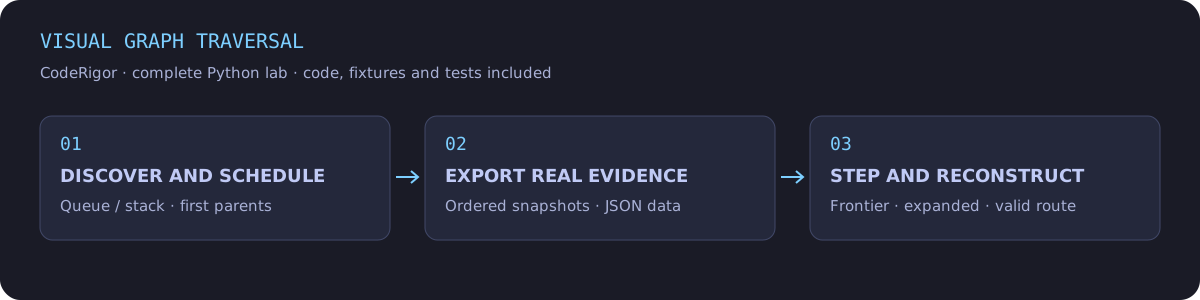
Enable JavaScript to step, play/pause and reset the supplied search traces, or download the Python lab and offline viewer.